US Approves Up to 300,000 Advanced AI Chip Exports to Qatar Through 2028
Up to 100,000 go to Qai, the Qatar Investment Authority's national AI company, and up to 200,000 to US-run data centres in Qatar, with compliance monitored by Commerce.
·2 min read
Prefer Nakoda News on Google
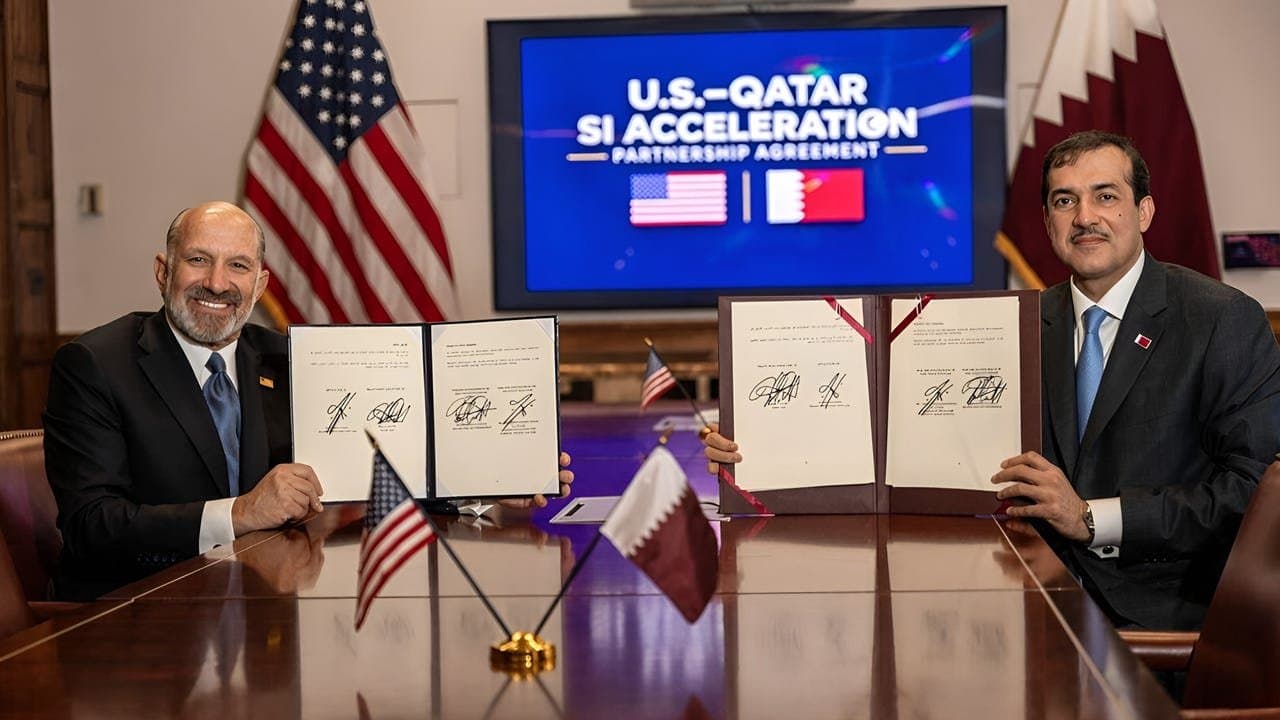
The United States has agreed to authorise exports of up to 300,000 advanced AI chips to Qatar through 2028 under a partnership signed in Washington this week, Middle East AI News reported. The US Department of Commerce puts the value of the semiconductors at tens of billions of dollars.
Under the Super Intelligence Acceleration Partnership Agreement, up to 100,000 of the chips are set aside for Qai, the national AI company launched by the Qatar Investment Authority in December 2025. Up to 200,000 more are for data centres in Qatar run by US companies. The deal gives Doha its own formal arrangement for large volumes of US chips, putting it alongside the UAE and Saudi Arabia.
The chips come with conditions. The agreement sets security requirements for physical and remote access to the processors and requires know-your-customer checks. The Commerce Department's Bureau of Industry and Security will monitor compliance on an ongoing basis, as it does under earlier deals in the region.
Commerce Secretary Howard Lutnick and Dr. Ahmad bin Mohammed Al Sayed, Qatar's Minister of State for Foreign Trade Affairs, signed the agreement in Washington during the Eighth Qatar-US Strategic Dialogue.
Qatar's Ministry of Commerce and Industry said the agreement aims to strengthen cooperation on AI, advanced semiconductors and digital infrastructure. It also seeks to ease access to advanced technology and to encourage investment between private-sector firms in both countries.
Washington is still signing chip deals with Gulf states while it tightens controls elsewhere. Earlier this month the US restricted exports to five countries, including Singapore and Malaysia, after investigating suspected chip diversion. Large AI export agreements with Gulf states have gone ahead despite significant pushback in Washington over security concerns.
Qatar has linked the new agreement to Pax Silica, the US-led initiative to secure AI and semiconductor supply chains. Doha signed the Pax Silica declaration in January 2026, joining Saudi Arabia and the UAE.
During the same dialogue, Qatar and the US signed a memorandum of understanding on critical minerals and rare earth elements. It covers supply chain security and joint investment in mining and processing.
The agreements follow an economic partnership worth at least $1.2 trillion, including direct investment in the United States, signed during President Donald Trump's state visit to Qatar in May 2025. The US ran a $2.4 billion trade surplus with Qatar in 2025 and has had a positive balance with the country since 2003.
The chips will feed an AI build-out that Qatar has been putting together in stages since its first national AI strategy in 2019. Qai, now operating as a subsidiary of Doha Investment, was set up to develop, manage and invest in AI infrastructure at home and abroad. In October 2026, a Cabinet decision created a National Center for AI within the Ministry of Communications and Information Technology to lead the country's AI strategy, regulation and adoption.
Separately, the telecom operator Ooredoo already has an agreement with Nvidia to deploy thousands of Nvidia Tensor Core GPUs for an AI cloud services platform across its Middle East and North Africa business.
By
Nakoda News Gulf Desk
Business, technology and policy across the UAE, Saudi Arabia and the wider Gulf.
Related coverage
- AI

Emirati Genome Programme Reaches One Million Participants, 900,000 Reports Due in December
11 hours ago · 3 min read
AI UAE's defenseAI Launches With More Than 100 Engineers and Four Defence AI Products
11 hours ago · 2 min read
AI UAE and Lebanon Target One Million AI Prompters, Add Prize for Student Government Apps
12 hours ago · 2 min read
AI Indian AI Start-Ups Check Land Titles and Spot Potholes but Cannot Get Enough GPUs
Nov 17, 2026 · 3 min read
AI More Than 2,000 Library Items Undigitised as Board Member Seeks National Project
Nov 16, 2026 · 2 min read