Supreme Court Agrees to Hear Robinhood's Appeal Over 2021 IPO Disclosure Lawsuit
The justices will decide whether IPO issuers can be sued for leaving out interim financial data, with a ruling expected by the end of June.
By Nakoda News Desk
·2 min read
Prefer Nakoda News on Google
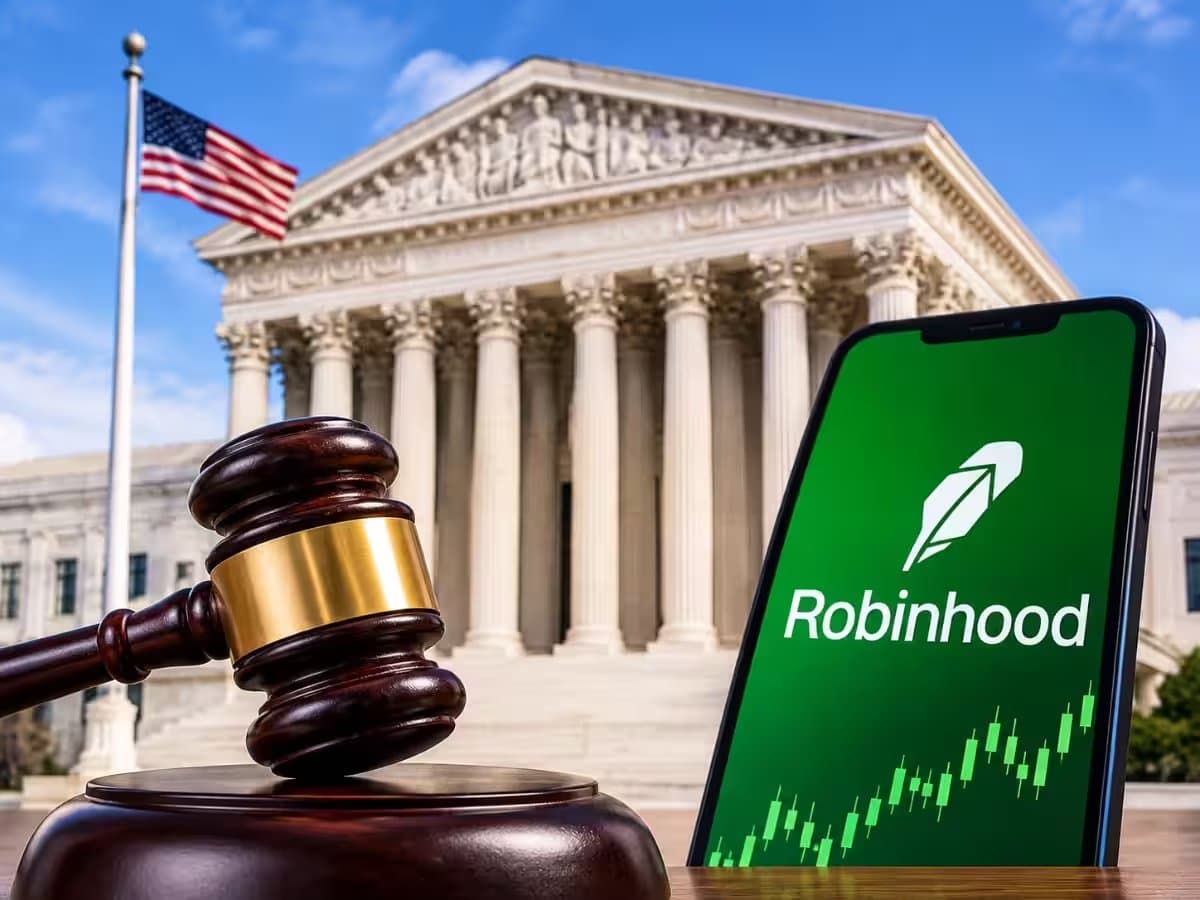
The US Supreme Court agreed on Friday to hear Robinhood Markets' bid to end a class action accusing the trading app of misleading investors before its July 2021 initial public offering, taking up a case that could reset how much financial information companies must put in IPO documents.
The investors, who sued in 2021 under the Securities Act of 1933, allege that Robinhood failed to disclose that its revenue had shifted towards meme-stock and dogecoin trading that was already fading before the listing, as well as an exodus of its traditional customers. The shares fell sharply after the company's first post-IPO results showed declining revenue and weaker key metrics. The suit names the company and the offering's underwriters, including Goldman Sachs and J.P. Morgan Securities.
The question for the court reaches beyond Robinhood. The justices are expected to decide whether a company can be held liable for omitting material financial information from an IPO registration statement without showing that the omission made a statement it did include misleading. A ruling for the investors would widen the disclosure duties of every company going public in the United States, while a ruling for Robinhood would narrow the grounds on which IPO buyers can sue.
US District Judge Edward Chen in San Francisco dismissed the case in 2024. The 9th US Circuit Court of Appeals revived it in 2025, finding that Chen had applied the wrong legal standards. The appeals panel said the registration statement "contained only limited information about Robinhood's performance during the second quarter of 2021", results the company reported only after the IPO.
Robinhood says its offering documents disclosed the risks extensively, including the possibility of a downturn from the peaks in meme-stock and dogecoin trading. It has argued that the 9th Circuit's ruling exposes companies to large liabilities and burdensome disclosure obligations. The Trump administration and the Securities and Exchange Commission urged the court to take the case and backed the company.
"We are pleased the Supreme Court has agreed to hear our case," Robinhood said in a statement.
The lead plaintiffs are Vinod Sodha, a psychiatrist from Beverly Hills, California, and his daughter Amee Sodha, a physician from Millburn, New Jersey. The case, Robinhood Markets v. Sodha, will be argued in the court's current term, with a decision expected by the end of June.
Sources
- Reuters · US Supreme Court to consider lawsuit over Robinhood's 2021 IPO
- The Economic Times · US Supreme Court to consider lawsuit over Robinhood's 2021 IPO
- CNBC · Supreme Court agrees to hear Robinhood challenge to IPO information omission lawsuit
- Investing.com (Reuters) · US Supreme Court to consider lawsuit over Robinhood's 2021 IPO
Produced with AI assistance from the sources above. How we work
By
Nakoda News Desk
Nakoda News covers AI and business. Every story links the sources it draws on; how we work is set out in our editorial standards.
Related coverage
Markets Nvidia Results and Anthropic's Nasdaq Debut Set Up a Two-Day Test for the AI Trade
8 hours ago · 3 min read
Markets Amodei Tells Dimon Compute Is Anthropic's 'Deepest Business Dilemma' Days Before IPO
16 hours ago · 2 min read
Markets Chip Stocks Lead Wall Street Lower as 10-Year Treasury Yield Climbs to 5.17%
17 hours ago · 2 min read
- Markets

Banks Turn Away Orders From China and Hong Kong for Anthropic's IPO
18 hours ago · 1 min read
- Markets

IEA Says Oil Market Is Returning to Surplus as Gulf Exports Recover From the Iran War
21 hours ago · 2 min read