Nvidia Previews Rubin HPC GPU With Over 50,000 CUDA Cores for Science, Shipping 2028
The chip adds sparse data acceleration and a new version of NVLink. It arrives with new CUDA-X libraries, an AI bundle for researchers and a quantum platform built with IBM and Fermilab.
·2 min read
Prefer Nakoda News on Google
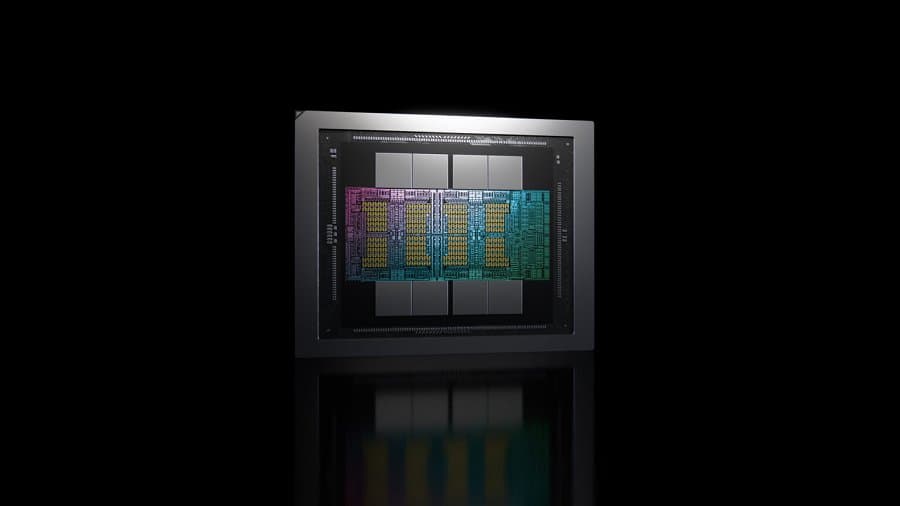
Nvidia has previewed Rubin HPC, a graphics processor for scientific research with more than 50,000 CUDA cores, at the SC26 supercomputing conference in Chicago, SiliconANGLE reported. The chip will ship in 2028.
That is significantly more cores than Nvidia's current flagship. The Rubin GPU has 898 Tensor cores, circuits optimised for large language models, and more than 28,000 CUDA cores. CUDA cores can run LLMs but also other workloads, such as scientific simulations.
Rubin HPC will include a "sparse data acceleration" feature. Sparse data means datasets that contain a large number of zeros. Many scientific projects produce it, particularly in biology and astrophysics. A telescope, for example, might use zeros to represent sections of space with no visible stars.
The chip will also ship with a new iteration of NVLink, the interconnect Nvidia's GPUs use to exchange data with central processing units. The current version moves 3.6 terabits per second per graphics card.
"For agents tackling science and engineering, faster simulation means faster discovery," said Ian Buck, Nvidia's vice president of hyperscale and high-performance computing. "Rubin HPC accelerates the simulations agents use to test ideas and guide their next steps, helping scientists and engineers explore more possibilities and bring breakthroughs closer."
Until the chip arrives, customers can use software tools Nvidia released alongside it. The company added several libraries to CUDA-X, the collection it ships with its GPUs. One of them, cuPhoton.xBeam, is meant to make it easier to analyse data from the Event Horizon Telescope network, a group of observatories used to study black holes. Nvidia said the library can do analysis tasks in eight minutes that once took a month. A second library, cuPhoton.xLens, simulates the plasma that fusion reactors use to generate electricity.
For biologists, Nvidia is open-sourcing cuSpa, which speeds up the cell polygon calculations used to study how cells are structured and how they interact. It is also offering an existing cellular analysis tool, rapids-singlecell, in a containerised format.
Nvidia also introduced Nemotron for Science, an AI bundle built on Nemotron 3.5 Super VL, the open-source LLM it released last month. The model has 124 billion parameters but activates only about a tenth of them at any given time, and it is partly based on Mamba-2, a more hardware-efficient alternative to the Transformer architecture. The bundle includes pre-packaged post-training workflows that researchers can use to tune the model for specific scientific tasks. It also contains nearly 50,000 chemistry questions for post-training models and evaluating ones that have already been trained.
On quantum computing, Nvidia expanded CUDA-Q, its software for linking quantum hardware to its GPUs and CPUs. The update adds new building blocks for writing quantum software and an algorithm that can mitigate qubit errors. Nvidia is also working with IBM and Fermilab, part of the U.S. Energy Department, on a "modular quantum codesign platform" that will pair Nvidia's DGX B200 systems with IBM quantum hardware. The companies said researchers will be able to use it to develop qubit error correction algorithms and other quantum software.
By
Nakoda News AI & Tech Desk
AI models, chips, products and research, and what they can and cannot do.
Related coverage
Products Rockwell Builds Nvidia Omniverse Into Emulate3D for Factory-Scale Simulation
8 hours ago · 2 min read
Products Nvidia Releases Nemotron for Science, an Open Model and Chemistry Dataset for Lab Agents
9 hours ago · 2 min read
Products Nvidia Readies 192-CPU Vera Rack for Science Simulation, With DKRZ Signed On
10 hours ago · 2 min read
Products e& Launches AIO Sovereign AI Platform for 20 Markets, Plans 200MW of Data Centre Capacity
10 hours ago · 2 min read
- Products
Mercedes-Benz Sets Spring 2027 for Hands-Free Highway Driving, City System Same Year
13 hours ago · 2 min read