GSMA Forecasts MENA Mobile Economy at $470 Billion by 2030 as MWC Doha Opens
The industry body's new reports find that 49% of the region's people stay offline despite living within network coverage, as operators turn from building 5G to earning from it.
By Nakoda News Desk
·2 min read
Prefer Nakoda News on Google
Mobile technology and services generated $380 billion of economic value across the Middle East and North Africa in 2025, equal to 5.8% of regional GDP, and that figure is forecast to reach $470 billion by 2030, according to a GSMA report released as MWC26 Doha opened on Monday.
The GSMA's Mobile Economy MENA 2026 report also found that 49% of the region's population remained offline in 2025 even though they lived within reach of a mobile network, while 48% used mobile internet. That gap between coverage and use is the region's main connectivity problem: for most people who are not online, the barrier is not the absence of a network.
The report puts the picture in stark terms for a region where some Gulf markets run among the world's most advanced 5G networks. According to the GSMA, 5G accounted for 9% of MENA mobile connections in 2025 and will reach 40% by 2030, with operators forecast to invest $88.9 billion over that period. The mobile ecosystem supported 2.2 million jobs and contributed $40 billion to public finances in 2025, the report said.
A second GSMA report published on the same day, 5G Monetisation MENA, looks at how operators are trying to turn that network spending into revenue. It found that 17 of the region's 24 markets had launched commercial 5G services by September 2026, and forecast that 5G connections will rise from 67 million in 2025 to almost 350 million by 2030. Operators are expected to spend a further $53 billion between 2026 and 2030 on wider coverage and 5G standalone networks. Fixed wireless access, which delivers home broadband over the mobile network, is the clearest source of new consumer revenue so far and is offered on about 64% of the region's commercial 5G networks, the report said.
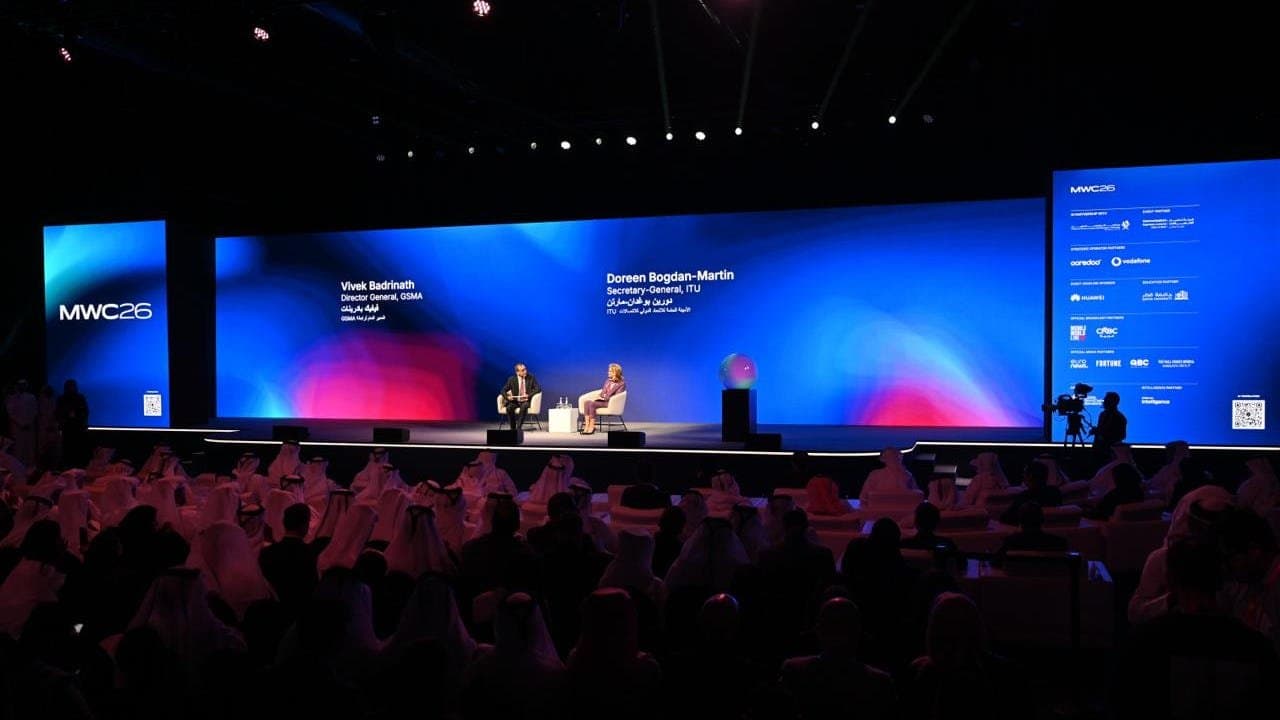
The second edition of MWC Doha is being held at the Doha Exhibition and Convention Centre in partnership with Qatar's Ministry of Communications and Information Technology. For the first time, the GSMA event is co-located with a meeting of the International Telecommunication Union: the ITU Plenipotentiary Conference, PP-26, which Qatar's Communications Regulatory Authority is hosting. The plenipotentiary meets every four years and is the UN agency's highest decision-making body, setting its strategic and financial plans and electing its leadership.
Opening the event, Qatar's Minister of Communications and Information Technology, Mohammed bin Ali Al Mannai, tied network investment to the next phase of AI. "As artificial intelligence advances towards executing tasks through intelligent agents, the need for more resilient networks and advanced computing capabilities continues to grow," he said, adding that global challenges had shown the importance of diversifying connectivity routes and keeping services running.
GSMA Director General Vivek Badrinath, speaking in a fireside chat with ITU Secretary-General Doreen Bogdan-Martin, set out two priorities: common global standards that keep networks, services and devices working across borders, and connecting the people in the region who remain offline. "Progress only counts if everyone shares in it," Badrinath said.
MWC26 Doha runs until 10 November.
Sources
- TahawulTech · GSMA MWC26 Doha opens with call to align on global industry standards and close MENA’s connectivity gap
Produced with AI assistance from the sources above. How we work
By
Nakoda News Desk
Nakoda News covers AI and business. Every story links the sources it draws on; how we work is set out in our editorial standards.
Related coverage
- Research

Amazon Researchers Release HOPE, a Method for Cutting Unused Experts From MoE Models
12 hours ago · 2 min read
Research Toshiba Europe Wins UK Contract to Build Quantum Network Technology With BT and Colt
15 hours ago · 1 min read
- Research
UAE and Saudi Firms Plan to Outspend Global Average on Digital Transformation, GSMA Finds
15 hours ago · 2 min read
- Research
Battery Backups Checking Their Charge in Sync Cause Minute-by-Minute Grid Dips, Study Finds
1 day ago · 3 min read
Research Open-Source Llama-Modchip Runs 284B-Parameter DeepSeek Model on a 64GB PC Without a GPU
1 day ago · 2 min read