Google Says Its /teamwork AI Agents Solved Long-Open Problems, Opens Them to Researchers
Multi-agent workflows built on Gemini 4 produced formal proofs, a Rust rewrite of a video decoder and scheduling gains inside Google, the company says.
By Nakoda News Desk
·3 min read
Prefer Nakoda News on Google
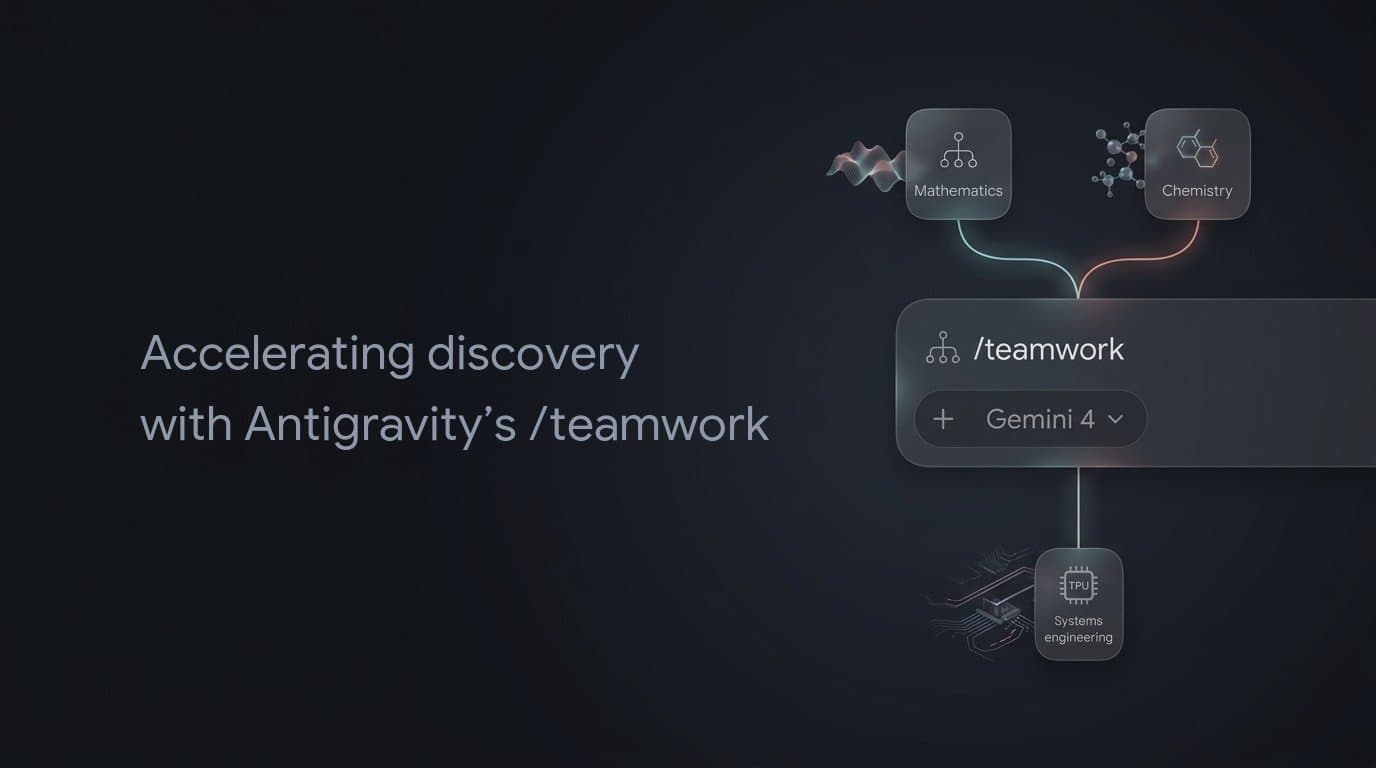
Google says teams of AI agents running on its Gemini 4 models have helped settle several mathematical problems that had been open for years. The agents also produced verified engineering improvements inside the company's own infrastructure. Google is making the tools behind this work available to outside researchers and developers through its Antigravity coding platform.
In a Google Research blog post published on Friday, Vahab Mirrokni, a Google Fellow and vice president at Google Research, described results from /teamwork, a multi-agent system in Antigravity. He wrote that the work was done with human experts at Google and partner universities and covered mathematics, chemistry, systems software and machine learning engineering.
For companies, the post is a concrete test of whether AI agents can take on long research and engineering tasks with checkable results. Google is backing that claim with free access for 10,000 academic researchers.
How the System Checks Its Work
Mirrokni said /teamwork is designed around two weaknesses of current language models. The first is that a single attempt from a model is unreliable. The system therefore runs many attempts in parallel and passes them to what Google calls falsifiers, such as the Lean 4 proof checker, unmodified software test suites, simulators and hardware counters, which confirm which candidate solutions actually work.
The second is that models lose track of detail over tasks lasting several days. To deal with this, /teamwork gives each specialised agent only the files and tools it needs for its step. Coordinators hand work on to fresh agents, and separate critic and auditor agents review results without seeing the original agent's reasoning. A simpler loop that solves a problem and then verifies the answer is packaged on its own as /boost.
Proofs, Molecules and Code
The best-known result is a proof of the Courtade-Kumar conjecture in information theory, posed in 2013. Researchers from Google, CUHK, USC and CMU proved it in full generality. According to the post, Gemini models first found counterexamples to a broader version of the conjecture, then developed most of the new analytical bounds and extended the proof to unbalanced functions without human input. The full proof was formalised in Lean 4 and runs to 50 million lines of code. Google also said its agents produced a machine-checked formalisation of the Weil conjectures, about 1.8 million lines of Lean generated across 28,800 subagent calls, and closed a gap in adaptive data analysis that had been open since 2014.
In chemistry, a system of 30 agents paired with a spectral simulator worked out molecular structures from NMR data. Google said it identified the exact structure as its first answer 95% of the time on complex benchmark molecules, and among its top three answers every time. That is close to double the accuracy of a single agent.
In engineering, agents rewrote the libgav1 AV1 video decoder in about 170,000 lines of Rust. Google said the rewrite matches the original bit for bit and, after optimisation, runs 20% to 30% faster than the C++ and hand-tuned assembly code on x86_64 and ARM chips. Inside Google, two agent-designed changes to its Borg cluster scheduler cut preemption of TPU workloads by 24% on some hardware types. A fleet-wide memory project saved more than the 1 PiB initially estimated.
All of these results come from Google's own account. The company said human researchers verified and edited them for publication, and many of the proofs were checked by machine in Lean 4.
Gemini 4 models with /teamwork and /boost are available in Antigravity now, Google said, along with Deep Review, a tool for checking manuscripts that includes two free calls a week. Authors of 578 submissions to the STOC 2027 computer science conference opted into Deep Review. Applications are open for 10,000 academic researchers to receive six months of free access at the highest usage tier. Google said a formal-proof workflow, a code-rewrite workflow and other specialised workflows will follow in the coming weeks.
Sources
- Google Research · Advancing science & engineering with Antigravity’s /teamwork
Produced with AI assistance from the sources above. How we work
By
Nakoda News Desk
Nakoda News covers AI and business. Every story links the sources it draws on; how we work is set out in our editorial standards.
Related coverage
- Research
Tether Releases BotPsy, a 0.8-Billion-Parameter Agent Model Built to Run on Devices
3 days ago · 2 min read
Research Meta Researchers Release e-means, a Faster Replacement for k-means Clustering in FAISS
3 days ago · 1 min read
- Research
UAE's First Radar Satellite Sirb-1 Clears Final Design Review, Targets 2028 Launch
3 days ago · 2 min read
- Research

Startup PSI Uses Anthropic Model to Prove a Long-Open Quantum Computing Conjecture
3 days ago · 2 min read
- Research
Nvidia Unveils GR00T 2, a Robot Model That Learns New Tasks From Human Video
3 days ago · 3 min read