Nvidia Unveils GR00T 2, a Robot Model That Learns New Tasks From Human Video
The world-action model was trained mostly on first-person footage of people working and reached 95% success with five demonstrations per task. Nvidia plans to open-source the weights in December.
By Nakoda News Desk
·3 min read
Prefer Nakoda News on Google
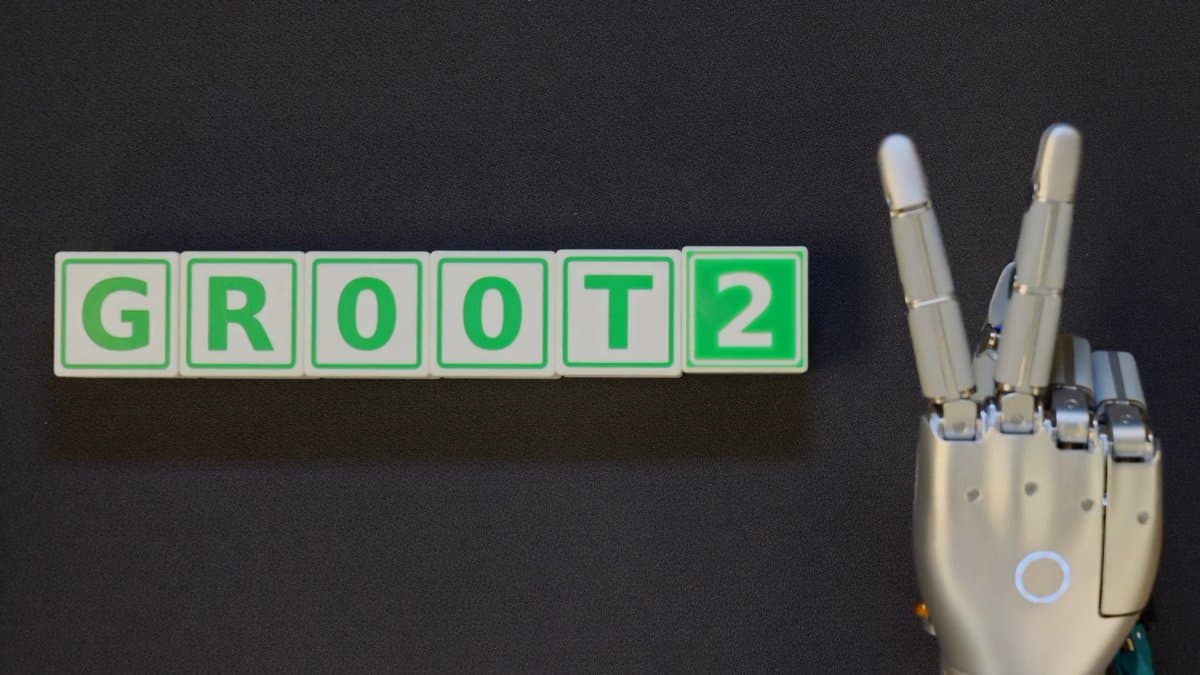
Nvidia has unveiled GR00T 2, a robot foundation model that learns new manipulation skills from recordings of people rather than from hours of robots being steered by remote control. The company plans to release the model's weights in December.
Jim Fan, Nvidia's director of robotics, presented the model on November 9 at the Conference on Robot Learning in Austin, Texas, Humanoids Daily reported. Nvidia has also published a research report on the system.
The model targets one of robotics' most expensive bottlenecks. Training a robot on a new task usually means engineers teleoperate it, or control it remotely, for hours, and the data collected for one robot model often cannot be reused on another. If skills can be learned from video of human hands, much cheaper footage could replace that data collection.
Predicting the Next Few Seconds
GR00T 2 is what Nvidia calls a world-action model. Its predecessor turned camera images and language instructions directly into motor commands. GR00T 2 instead predicts a short video of what should happen next and the movement needed to get there, both at once. According to The Decoder, Nvidia says that video prediction lets skills carry over between robots with different bodies.
The model has 2 billion parameters and is built on Nvidia's Cosmos models, Humanoids Daily reported. It was pretrained on 402,730 hours of first-person video, 10,184 hours of demonstrations recorded with handheld grippers and 23,500 hours of robot teleoperation, and The Decoder said training ran on a cluster of more than a thousand GB300 chips. Nvidia has published the first 100,000 hours of its in-house human video on Hugging Face as a dataset called Human-1M-100K.
To teach a new task, a person demonstrates it wearing data gloves or a finger exoskeleton, or using a handheld gripper. During training, the model learns to draw the robot's arm in place of the human arm in its predicted video and works out the matching control commands.
Across 50 tasks on a two-armed robot with Sharpa hands, the model averaged 40% success with no demonstrations, 71% with one per task and 95% with five, Humanoids Daily reported. It said the model is adapted to a task in a 30-minute fine-tune on a single RTX 5090 graphics card. In other lab tests described by The Decoder, robots lit a match, sliced a banana and tossed packages onto a conveyor, with success rates between 10% and 80% depending on the task.
A Reasoning Model on Top
For longer jobs, Nvidia pairs GR00T 2 with a larger language model, such as OpenAI's GPT-6 Astra, which breaks the work into steps and starts recovery routines when a part is dropped. With that pairing, a robot assembled toy models from scattered parts in at least 97% of trials. Without the planner and extra fine-tuning, it completed the toy car assembly 23 times out of 100. "Neither Astra nor GR00T can do this alone, and you need both," Fan said, according to Humanoids Daily.
The planner slows the robot down. In a trash-sorting test, the robot stood idle for about a third of the time, waiting more than seven seconds on average for each new plan. The researchers also said the model cannot yet use touch sensors and sometimes misses small errors, such as a screw left half-turned.
A smaller version, GR00T 2 Turbo, processes four times fewer video tokens so it can run on the robot itself. On a Unitree G1 humanoid it runs on Nvidia's Jetson AGX Thor computer and takes 124 milliseconds per prediction. In tests the humanoid scooped popcorn and cleared tables, but succeeded just under half the time at wiping up spills with a towel under its foot.
Humanoids Daily reported that Foxconn, Siemens, Nexuni and MicroAGI are early users. Nvidia plans to release the GR00T 2 and Turbo weights, together with its training recipe for transferring skills between robot bodies, in December. It has not yet published license terms for the weights.
Sources
- The Decoder · Nvidia's model GR00T 2 watches humans on video, then imagines itself as the robot
- Humanoids Daily · "Robotics Is No Longer an Elitist Sport": NVIDIA Unveils GR00T 2 and Open-Sources the Stack Behind It
Produced with AI assistance from the sources above. How we work
By
Nakoda News Desk
Nakoda News covers AI and business. Every story links the sources it draws on; how we work is set out in our editorial standards.
Related coverage
- Research
Anthropic's Fable 5.2 Completes 41% of Real Freelance Jobs on Remote Labor Index
12 hours ago · 2 min read
Research Insilico Medicine Open-Sources Longevity Grok, a Health AI That Scores Its Own Predictions
14 hours ago · 2 min read
- Research
Google DeepMind Uses AI Tool to Formally Verify Key Guarantees of the Signal Protocol
21 hours ago · 2 min read
Research Anthropic Says Claude Designed Three Working Electronic Devices With Little Human Help
1 day ago · 3 min read
Research Two UAE Firms Field-Test Water-Saving Greenhouse and Soil Technologies in Al Ain
1 day ago · 2 min read