Fervo's Contracted Revenue Jumps to $11.9 Billion on 396MW Google Geothermal Deal
The geothermal developer's first Utah plant is now selling power, and it expects to finish its 100-megawatt first phase by January 1 while building eight more units for Google.
By Nakoda News Desk
·3 min read
Prefer Nakoda News on Google
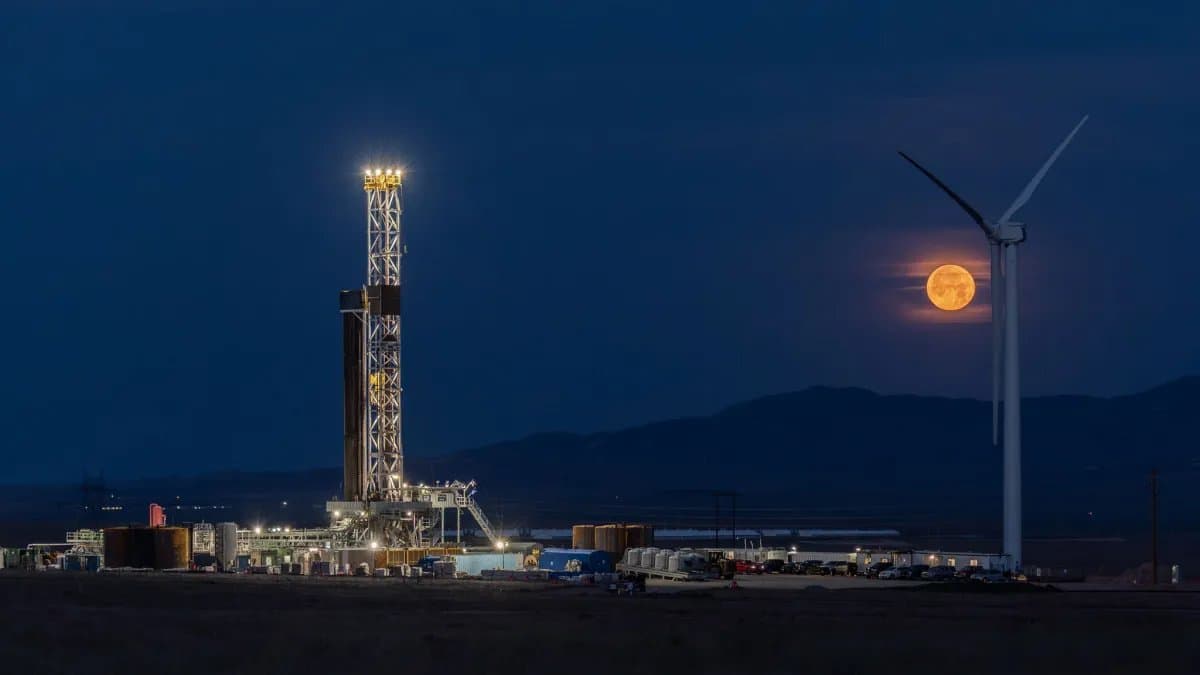
Fervo Energy said on Monday that it now has about $11.9 billion of contracted revenue under binding power purchase agreements, up from about $7.2 billion three months earlier, as the geothermal developer brought its first plant into commercial service and signed up Google for most of its next build.
In its third-quarter results, the Nasdaq-listed company said it has 1,054 megawatts under binding contracts, against 658 megawatts at the end of June. The 396-megawatt increase matches a 15-year, take-or-pay agreement with Google covering eight of Fervo's GeoBlock units at Cape Station in Beaver County, Utah, which the company described as the largest enhanced geothermal power purchase agreement signed to date.
The numbers matter beyond Fervo. Technology companies building AI data centres are competing for firm, round-the-clock electricity, and new gas turbines and nuclear plants take years to arrive. Fervo is pitching geothermal as power that can be built in blocks sized to a data centre hall and switched on as each is finished.
The Google Contract
Under the agreement, which Fervo calls Cape Google 400, first power is expected in mid-2028 and full capacity by the end of that year. The plant will be connected to the grid, which means Google can draw the power or sell it on if it is not ready to use it. Tim Latimer, Fervo's co-founder and chief executive, told analysts that neither side has to wait for the other, according to TechCrunch's account of the call. "We build Cape Station on our schedule. Google can develop a potential data center on their schedule," he said.
Google also has an option to add about 600 megawatts, which would take the total to nearly one gigawatt, the company said. Any expansion would be delivered behind the meter, direct to a load such as a possible regional data centre in Beaver County, under Utah's SB132 framework. It would be the first project under a geothermal framework agreement the two companies signed in March 2026, which covers up to 3 gigawatts through 2033.
Fervo said drilling for the Google units is about 18% complete and that the first set of 50-megawatt turbines has passed factory acceptance testing.
Plants Coming Online
The first 33-megawatt GeoBlock at Cape Station was declared in commercial operation on September 30, ahead of its contractual date, the company said. A second unit has been synchronised with the grid and is delivering test energy, and a third is mechanically complete and in cold commissioning. Fervo expects both to reach commercial operation by January 1, 2027, completing the roughly 100-megawatt first phase. A new study by DeGolyer and MacNaughton put the Cape Station resource at about 8.4 gigawatts, nearly double an earlier estimate of 4.3 gigawatts.
Cost is the test investors are watching. Fervo expects the first phase to cost about $7,000 per kilowatt, is targeting $5,500 per kilowatt for the Google project and has set a long-term goal of $3,000 per kilowatt. At that level, it says, geothermal could compete with gas-fired generation.
Cash, Losses and Spending
Revenue was $116,000 for the quarter, before the first full quarter of sales from Cape Station. The operating loss widened to $43.7 million as general and administrative costs rose to $39.4 million from $27.4 million. Net income came in at $11.7 million, helped by a $29.9 million tax benefit and an $11.8 million non-cash gain on swaps. The release gave two figures for the loss attributable to common stockholders: $20.8 million in its highlights and $19.5 million in its financial tables.
Fervo ended September with about $1.9 billion in cash and $301.6 million of debt. Capital spending was $256.7 million in the quarter. The company cut its second-half capital expenditure forecast to $700 million to $750 million from $850 million to $900 million, saying construction efficiencies had pushed some Google project spending later without changing completion dates or total investment. It expects fourth-quarter capital spending of $450 million to $500 million and holds an investor open house at Cape Station on November 19.
Sources
- TechCrunch · Fervo now has $12B in orders for its geothermal power tech
- Fervo Energy (GlobeNewswire via The Manila Times) · Fervo Energy Reports Third Quarter 2026 Results
Produced with AI assistance from the sources above. How we work
By
Nakoda News Desk
Nakoda News covers AI and business. Every story links the sources it draws on; how we work is set out in our editorial standards.
Related coverage
- Companies
Nvidia and Jensen Huang Sued by Shareholder Over Ties to Suspected Chinese Spy
2 hours ago · 3 min read
- Companies
Nvidia's Board Faces Governance Test as Gensler Says Huang Appears to Have Misled Public
3 hours ago · 3 min read
- Companies

Skydance Breaks Down $6 Billion Cost-Savings Plan, Citing AI and Back-Office Cuts
3 hours ago · 2 min read
- Companies
Jensen Huang Pulls Out of ElevenLabs Summit and Anthropic CEO Forum as Nvidia Inquiry Runs
4 hours ago · 2 min read
- Companies
Lead Director Stephen Neal Expected to Play Central Role in Nvidia's Huang Inquiry
4 hours ago · 2 min read