Sparxity, Formerly SpiNNcloud, Closes Series A to Take Total Funding to $90 Million
The Dresden chip company, backed by Lockheed Martin Ventures and GlobalFoundries, is building an inference chip it says could run ultra-sparse AI models up to 44 times faster.
By Nakoda News Desk
·2 min read
Prefer Nakoda News on Google
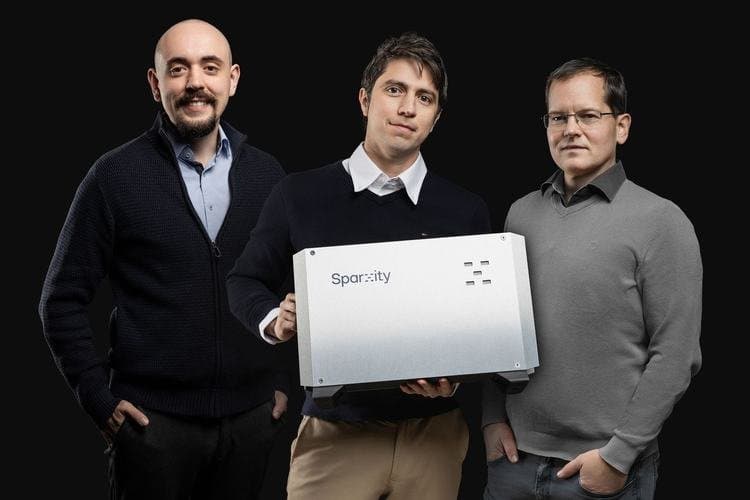
Sparxity, a German maker of chips and systems for sparse computing, has closed a Series A round that brings its total funding to $90 million. The company said it will use the money to develop a chip for AI inference on models that switch most of their parameters off for any given task.
The round was led by ICM HPQC Fund, a deep-tech investor focused on high-performance and quantum computing infrastructure, the company said in a press release. Lockheed Martin Ventures, chipmaker GlobalFoundries, GS Futures, Cloudberry Ventures, TGFS and the EIC Fund also invested. Angel investors include Richard Socher and Nancy Xu. Sparxity did not say how much of the $90 million came from the Series A.
The company was known until recently as SpiNNcloud. It said it changed its name to reflect a wider focus on sparse computing. The Dresden-based company is betting that the next gains in AI efficiency will come from hardware built for dynamic sparsity, where only a small, changing subset of a model's weights or neurons is active at once. Mixture-of-experts models, which route each token through a fraction of their parameters, use a coarse version of this idea. GPUs are designed for dense matrix maths and get less benefit from finer-grained sparsity.
Sparxity said its next-generation chip is designed for fine-grained dynamic sparsity and is targeting up to 44 times faster inference on ultra-sparse models. That chip is still in development. The company said it would give model developers room to build sparser architectures and give data centre operators higher throughput with lower energy and infrastructure costs.
"The next era of AI will be defined not just by how much computing power we can deliver," co-founder and chief executive Hector Gonzalez said in the release. He said efficient use of compute would matter as much.
Xu Owen He, a former Google DeepMind researcher who advises the company, said dynamic sparsity has shown potential, adding: "Yet today's hardware limits how far we can take these approaches."
The company says it already has a working business. It reported three chip tape-outs, more than 70,000 chips produced, 12 racks deployed and more than 30 customers worldwide, including some large supercomputing centres. It said revenue quadrupled between 2024 and 2025 and has kept growing in 2026, but did not give figures. These are company figures and have not been independently verified.
Sparxity said its current systems target high-performance computing and AI. On selected workloads it reported sparse solvers running 10 times faster, 18 times lower energy use for event-based machine learning, and 20 times shorter runtimes for optimisation problems.
Its best-known deployment is a multi-million-dollar system at the Jülich Supercomputing Centre, part of Forschungszentrum Jülich, which hosts Europe's first exascale supercomputer. Sparxity also has a partnership to bring its technology into data centres run by T-Systems, Deutsche Telekom's IT services arm. T-Systems chief executive Ferri Abolhassan said in the release: "We are looking forward to having Sparxity on board in our AI factory soon." Deutsche Telekom announced on the same day that it is expanding that Munich AI factory to 20 megawatts.
Matthew Gould of ICM HPQC Fund said Sparxity "has demonstrated the ability to manufacture its technology and deploy systems with major customers."
The company has not said when its inference chip will tape out or ship.
Sources
- DatacenterDynamics · Sparxity raises $90m following Series A funding round
- Business Wire · Sparxity Closes Series A, Bringing Total Funding to $90M
- Tech Funding News · Dresden's Sparxity hits $90M total funding as Lockheed Martin Ventures backs sparse AI chips
Produced with AI assistance from the sources above. How we work
By
Nakoda News Desk
Nakoda News covers AI and business. Every story links the sources it draws on; how we work is set out in our editorial standards.
Related coverage
- Companies

Mercor Raises $750 Million at $20 Billion Valuation to Sell AI Agent Testing to Enterprises
6 hours ago · 2 min read
Companies Booz Allen Moves Its Defence and Cyber Software From Anthropic Models to Nvidia's Nemotron
7 hours ago · 2 min read
Companies OpenAI Tells Investors Third-Quarter Revenue Rose Nearly 50% to $10 Billion
7 hours ago · 2 min read
- Companies

CoreWeave Raises 2026 Forecast as Revenue Jumps 168% and Backlog Hits $132.5 Billion
7 hours ago · 3 min read
- Companies

X-energy Wins US Permit to Build Four Small Modular Reactors at Dow's Texas Plant
8 hours ago · 2 min read