Ai2 Releases ToyBlocks, an Open Simulated World for Studying How Robots Learn
The tabletop framework produced 85,336 long-horizon demonstrations, and a planning model paired with an action policy succeeded in half of real-robot trials.
By Nakoda News Desk
·2 min read
Prefer Nakoda News on Google
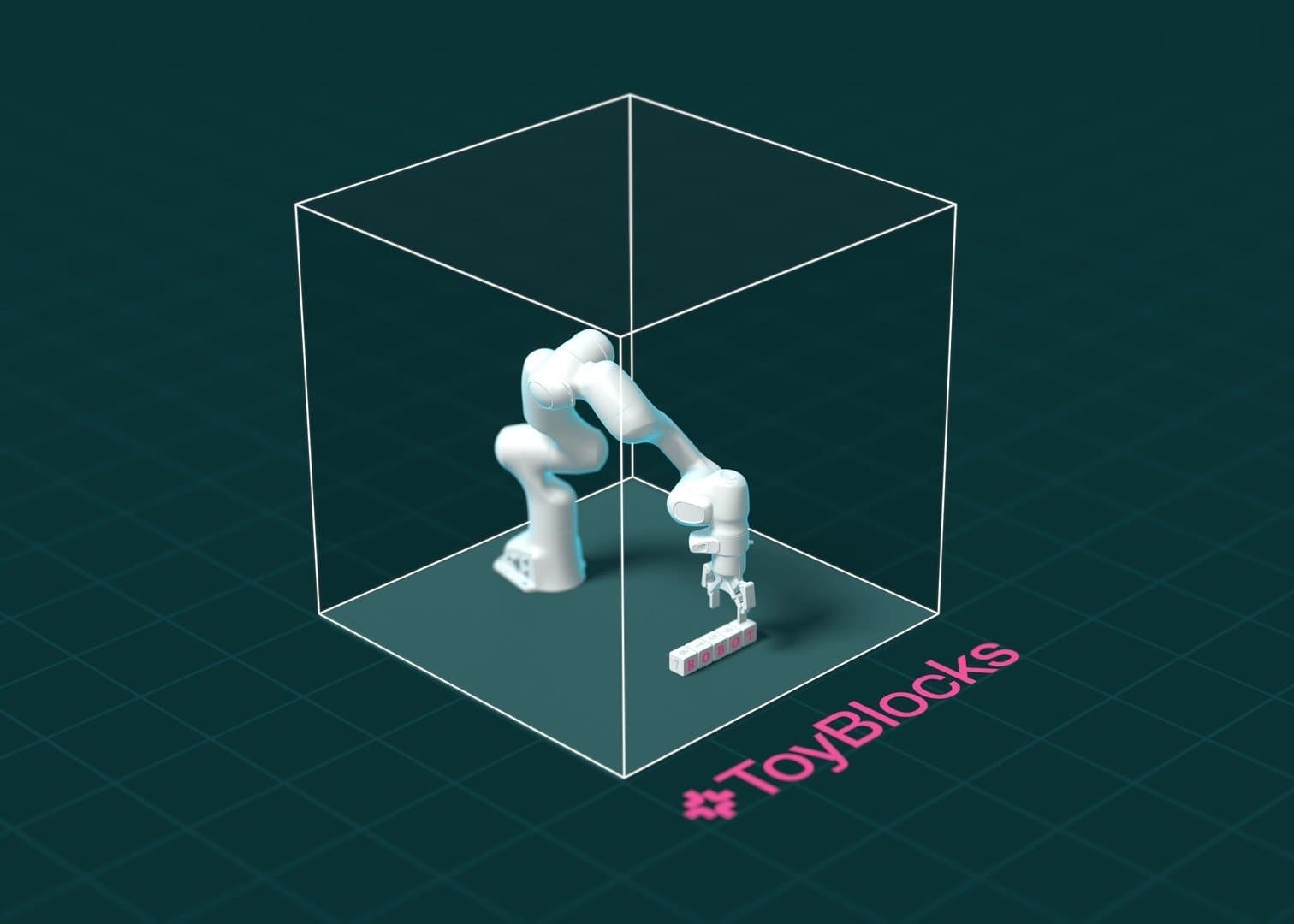
The Allen Institute for AI (Ai2) has released ToyBlocks, an open simulation framework in which a robot arm pushes, flips, stacks and sorts lettered blocks on a tabletop. The institute says the deliberately narrow setting lets researchers find out what a robot has actually learned and why it fails.
ToyBlocks is the first of what Ai2 calls FoundationWorlds. Each is a controlled simulated environment that comes with tools for automatically generating tasks and training demonstrations, plus metrics for tracking a robot's behaviour. Ai2 argues that robot demonstrations such as laundry folding are often too narrow to explain failures, and that robotics needs settings where researchers can change the training data or model design, repeat a test and trace the cause of an error, much as biologists use a petri dish.
The practical bottleneck it targets is data. ToyBlocks generates demonstrations automatically, without teleoperation, in which a person controls a robot remotely. Skills such as pushing or flipping a block are learned through reinforcement learning and motion planning in Nvidia's open-source Isaac Lab. A task-and-motion planner then chains these skills into longer tasks. Ai2 said the system runs hundreds of plans in parallel on a single GPU at up to 24 times real-time speed. The released dataset has 85,336 long-horizon demonstrations, nearly 1,600 hours of robot execution data and 144 million frames.
From Simulation to a Real Arm
Ai2 tested how well results carry over to a physical Franka FR3 arm with a Robotiq gripper, across 30 scene configurations of four to 10 blocks. Single skills performed by the ManiFlow action model succeeded 80.0 per cent of the time in simulation and 81.1 per cent on the real robot. A two-level system, with Ai2's Molmo 2 model choosing skills and ManiFlow executing them, succeeded in 55.5 per cent of simulated episodes on block-spelling tasks and 15 of 30 real-world trials. The researchers said more trials are needed for statistical confidence.
The team said popular vision-language-action models, including ManiFlow, π0.5 and Ai2's own MolmoAct 2, generalised poorly in initial results. Adding 100 rollouts generated by the best-performing video world model, Wan 2.2, raised a policy's success rate in an unseen region of the table from 19 per cent to 78 per cent.
The researchers also tested an agent built on Anthropic's Claude Opus 5.5. It solved all 30 block-stacking tasks both from text descriptions and from camera images. On a harder search-and-spell task, where half the scenes could not be solved, it succeeded or correctly declared the task infeasible 63 per cent of the time. Its errors came mostly from look-alike letters and misread letter orientation.
What Is Released
Ai2 has published the code, simulation assets, task and demonstration generators, the generated data, training and evaluation code, validation sets, and two trained models, Molmo2-4B-tb and maniflow-tb. ToyBlocks builds on the institute's earlier open robotics work, including MolmoAct 2, MolmoBot and MolmoSpaces.
Ai2 said a second release with a larger dataset, more skills and broader benchmarks will follow in a few weeks. Later work will add fully integrated reinforcement learning training, two-armed manipulation and dexterous hands with force and touch sensing.
Sources
- Hugging Face · ToyBlocks: A controlled world for robot learning and evaluation
Produced with AI assistance from the sources above. How we work
By
Nakoda News Desk
Nakoda News covers AI and business. Every story links the sources it draws on; how we work is set out in our editorial standards.
Related coverage
Research Chinese Models Take 89% of Enterprise Open-Source AI Spending, Menlo Ventures Says
11 hours ago · 3 min read
Research Anthropic Says Offline 'Dreaming' Lets Claude Correct and Organise Its Own Memory
14 hours ago · 3 min read
Research Unreleased Anthropic Model Helps Prove 2008 Quantum Speedup Conjecture, PSI Says
17 hours ago · 3 min read
- Research

Best AI Coding Agent Fully Completes Only 26.4% of Real User Requests in New Benchmark
17 hours ago · 3 min read
Research DeepSeek's Open Model Nears OpenAI's Restricted Cyber Model on Network Attack Test
19 hours ago · 2 min read