UAE National Library and Archives Calls for Ethical AI Frameworks as Conference Closes
The archive showed in-house visual search tools it says identify people, buildings, vehicles and landmarks within seconds, and a paper examined storing data in DNA.
·1 min read
Prefer Nakoda News on Google
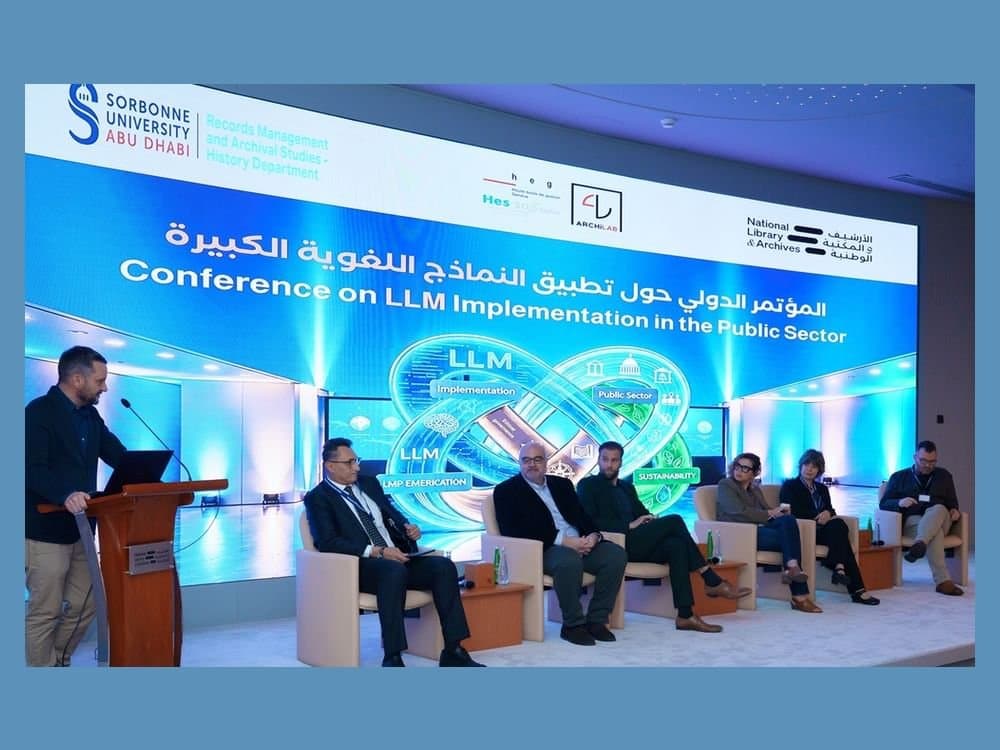
The UAE's National Library and Archives closed a three-day conference on large language models in government with a call from its acting executive director, Dr Hamad Abdullah Al Mutairi, for ethical frameworks to keep AI tools reliable and sustainable, the Emirates News Agency (WAM) reported on Sunday. Details were first published by wam.ae.
Al Mutairi, who is also vice-president for programmes at the International Council on Archives, said large language models represent a step change for government work and the production of knowledge. He pointed to uses in writing, translation and knowledge management. The conference, titled Application of Large Language Models in the Public Sector, was organised with Sorbonne University Abu Dhabi.
He said the technology strengthens the archive's role, which reaches beyond preserving historical documents to producing knowledge, consolidating national identity and giving the public access to authentic, reliable information.
Experts and academics at the conference discussed the use of AI in service efficiency, ethical governance and sustainability. Mohammed Adel Al Ash of the National Library and Archives presented in-house systems for automating archival work, analysing data and supporting decisions. They include text extraction tools, a smart platform called Al Thakira, Arabic for memory, and visual search systems that the archive says can identify people, buildings, vehicles and landmarks within seconds.
Rachid Al Tayeb Hamdache, also of the archive, looked further ahead in a paper titled Artificial Intelligence and the Future of Genetic Archiving. He examined storing large volumes of data for long periods in very small spaces using DNA molecules, and said AI could improve the accuracy of encoding and retrieving such data and cut energy use. Cost, retrieval speed and technical complexity remain obstacles, he said.
A second session covered the role of language models in preserving cultural heritage and the archive's work to safeguard cultural memory and open its sources to researchers and the public.
The report did not say which models the archive's tools run on or what governance rules apply to them. Al Mutairi said he hoped to continue working with the university through an International Conference on Digital Archives scheduled for January 2027.
By
Nakoda News Gulf Desk
Business, technology and policy across the UAE, Saudi Arabia and the wider Gulf.
Related coverage
- AI

Dubai Police Cuts Admin Procedures 40% to 1,670, Adds Agentic AI to Smart Stations
8 hours ago · 1 min read
- AI

MBRSG Opens Fourth IEEE Agentic AI Ethics Cohort as UAE Targets 50% of Government
10 hours ago · 1 min read
AI South Korea's Top Tax Accountant Exam Scorer Confesses to Cheating With Generative AI
14 hours ago · 2 min read
- AI
Hamdan bin Rashid Foundation and ATRC Sign Deal on AI Tools for Gifted Students
22 hours ago · 1 min read
AI AT&T Runs Nearly 500 AI Agent Workflows in Production, Plans to Triple Them Next Year
23 hours ago · 2 min read