IBM Research's Palette Trains a 20B Open Model to Build Slide Decks in a House Style
The researchers say the fine-tuned model ranks first on two of three PresentBench domains and comes within 1.1 points of NotebookLM on the overall average.
By Nakoda News Desk
·2 min read
Prefer Nakoda News on Google
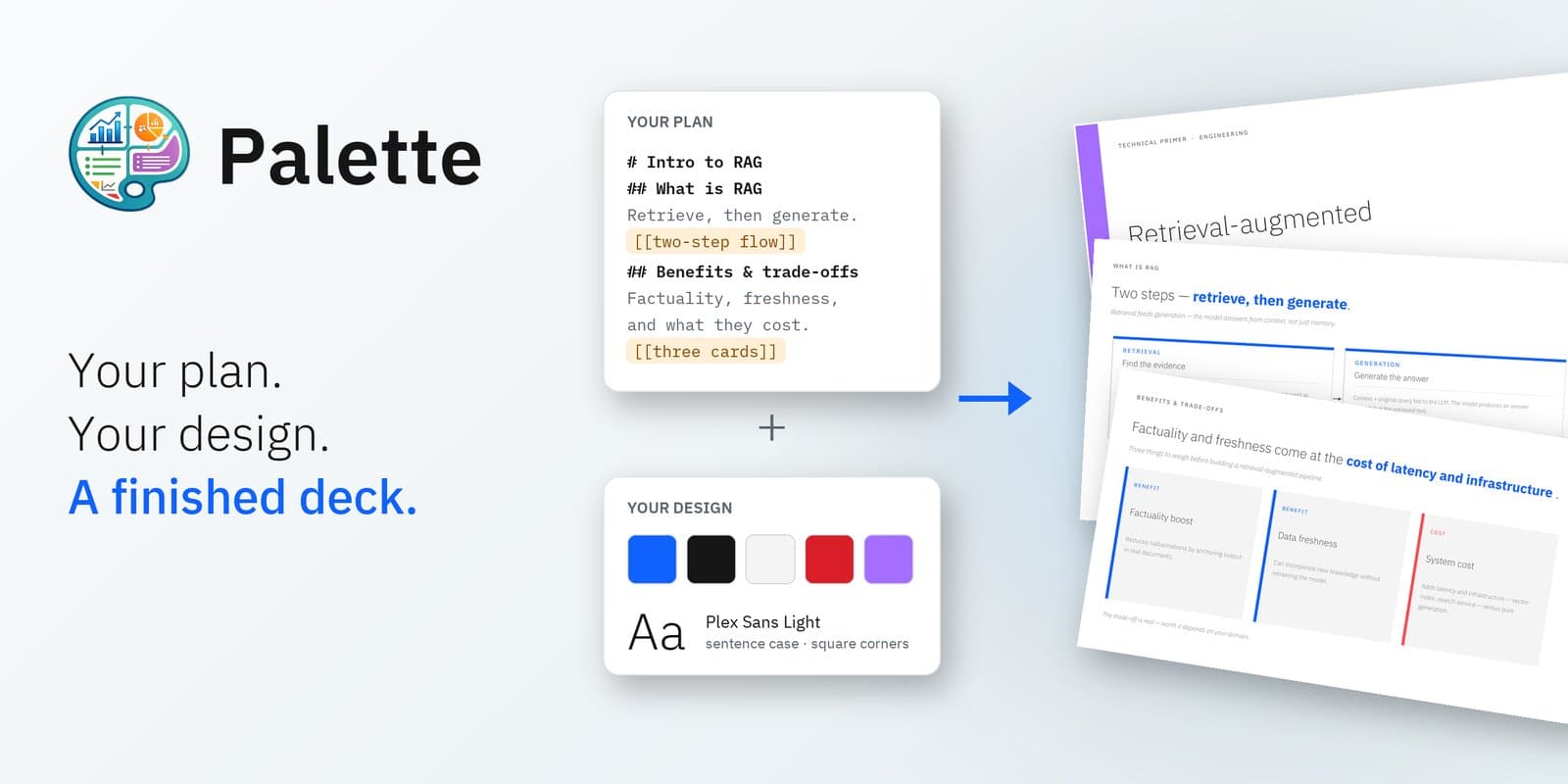
IBM Research has described Palette, a system that fine-tunes a small open-weight model to produce presentation decks that follow a company's own design language, in a post on the Hugging Face blog. The authors, Praveen Venkateswaran, Anupama Murthi and Hamid Adebayo, say the work aims to give companies a model they can run on their own infrastructure, so confidential content stays in-house and decks follow the company template instead of a frontier model's default style.
The team fine-tuned a 20-billion-parameter model using a LoRA adapter, with training data following the IBM Design Language. The post does not name the base model or say whether the model or its data will be released.
The system splits deck-building into two roles served by the same adapter. A designer role turns a user's plan into a structured brief that sets the palette, type and layout of each slide, with a short design rationale. A coder role then writes pptxgenjs JavaScript to draw each slide. Because each slide's specification is set before any code is written, the slides can be coded in parallel, which the researchers say makes that stage about six to seven times faster. The brief can also be edited, so a person or an agent can change one slide without regenerating the whole deck.
With no public dataset of design plans and slide code available, the team used a large open teacher model to generate about 1,000 decks covering roughly 10,000 slides. Every generated deck was rendered and checked for overlapping elements and text overflow, and broken slides were repaired and turned into new training examples. The researchers say the hardest problem was stopping the model from inventing facts, and that reference decks in the teacher's prompt worked far better than written rules.
At inference, a harness checks each slide and keeps a rewrite only if the checker confirms it improved. The post says the harness "can fix a slide, but it can't make one worse," and that it added 3.5 points on average across 131 decks.
On PresentBench, Palette ranked first on the Economics and Education domains and third on Talk, where two closed systems scored higher. Its three-domain average of 59.7 placed second, behind NotebookLM at 60.8. The comparison also included Manus 1.6 and five other systems, with baseline figures taken from the PresentBench paper.
For businesses, the work suggests that narrow, self-hosted models trained on synthetic data can come close to frontier tools on specific office tasks.
Sources
- Hugging Face · Palette: teaching a small model to build decks in your design language
Produced with AI assistance from the sources above. How we work
By
Nakoda News Desk
Nakoda News covers AI and business. Every story links the sources it draws on; how we work is set out in our editorial standards.