Democrats Win Governorships in States Holding 37% of Planned US Data Centre Capacity
Incoming governors in Texas, Georgia and Ohio have pledged to pause large projects, while Democrats in Congress agree on hearings but not yet on AI legislation.
By Nakoda News Desk
·3 min read
Prefer Nakoda News on Google
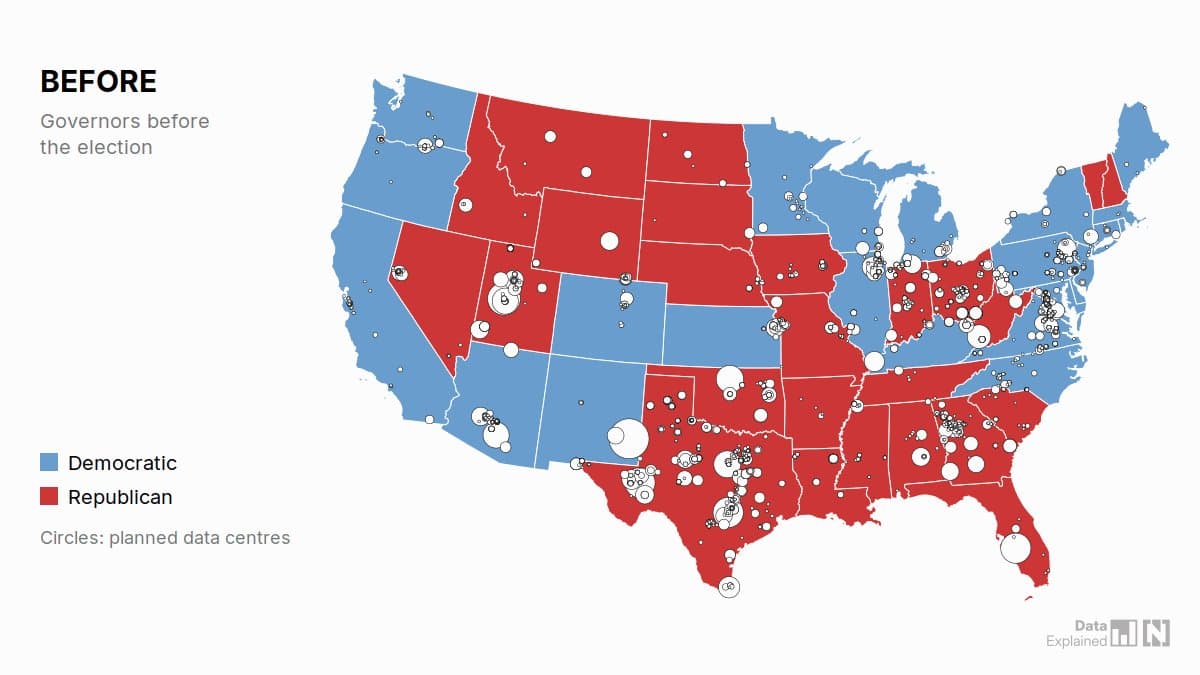
Democrats who won five governorships in Tuesday's US midterm elections will take charge of states that hold 37 per cent of the country's planned data centre capacity, according to The National's analysis of project data from Cleanview. Several of the incoming governors campaigned on slowing construction.
The party flipped the governor's offices in Texas, Georgia, Ohio, Iowa and Nevada. Texas alone accounts for 22.8 per cent of planned US capacity. Its incoming governor, Gina Hinojosa, has promised a moratorium on new data centres and more say for communities over where they are built, The National reported. Keisha Lance Bottoms in Georgia and Amy Acton in Ohio have pledged to pause construction of large facilities.
In the short term, governors have more influence over the build-out than most federal action could. They appoint the utility regulators who set electricity prices and approve grid connections, and they shape the tax incentives states use to attract projects, although local authorities keep important planning powers. For developers, and for the cloud and AI companies that lease their capacity, the country's biggest pipeline of projects now sits under leaders who have promised to slow it. US data centre capacity under construction rose 48 per cent between December and June, according to the real estate firm Cushman & Wakefield.
Moratoriums on the Ballot
Voters also decided on data centres directly. Citing Ballotpedia, Reuters reported that 38 local jurisdictions across 10 states put at least 41 data centre measures to voters, 21 of them in Ohio. Voters approved nearly every moratorium on the ballot. Democrats also flipped seven Senate seats in states that together hold 32 per cent of planned capacity, according to The National's analysis.
Voters ranked the cost of living, groceries and health care above data centres. But rising electricity bills, and the question of who pays for the grid upgrades the AI build-out needs, have tied the two together. Mark McCarthy of Georgetown University told The National that the new Congress was more likely to protect households from data centres' power costs than to pass sweeping change, because President Donald Trump keeps his veto.
Hearings First, Legislation Later
In Washington, Democrats agree that AI will be a priority but not yet on what to do about it. "We know how important this is, and it is going to be a high priority for Democrats," Representative Greg Stanton of Arizona, a member of the New Democrat Coalition, told reporters on Wednesday. He acknowledged that the party had not yet agreed on a specific policy.
So far, the common ground is oversight. Representative Greg Casar of Texas, who chairs the Progressive Caucus, said Democrats would "call the AI CEOs to testify under oath, not cash their checks." Representative Ted Lieu of California told reporters that the party would hold public hearings on AI and pass "reasonable guardrails". Representative Josh Gottheimer of New Jersey told Semafor that Democrats were in "surprisingly broad agreement" on the need for common-sense rules.
The divisions appear on the more ambitious proposals. A Democratic congressional staffer told Semafor they doubted that Democrats in either chamber would broadly back Casar's bill to pause development of advanced AI models, and expected Senate leaders to cater to moderates. The staffer said Democrats could use their subpoena power to seek Trump's June executive order on AI, which has never been fully released, and to examine the administration's use of export controls. In the Senate, any major AI safety bill would go through the Commerce Committee. Its top Democrat, Maria Cantwell of Washington, has been pushing a bill that would require independent testing of AI models before release.
Hakeem Jeffries, in line to become speaker with the largest House majority in decades, said Democratic leaders would discuss AI as a caucus. The party's initial agenda centres on health care subsidies, tariffs and ending the Iran war. The new Congress and most of the new governors take office in January.
Sources
- The National · Democrats’ midterm gains put US data centre boom under pressure
- Semafor · Democrats are fired up on AI. Consensus is harder.
- Semafor · House Democrats debate their agenda
Produced with AI assistance from the sources above. How we work
By
Nakoda News Desk
Nakoda News covers AI and business. Every story links the sources it draws on; how we work is set out in our editorial standards.
Related coverage
- Policy

UAE Adds AI Categories to Government Excellence Award, Honouring Tax Authority's AI Chief
3 hours ago · 2 min read
Policy UAE Banks Federation Chief Flags AI-Driven Fraud and Cloud Concentration Risk
4 hours ago · 1 min read
Policy DIFC Courts Propose On-Chain Dispute Standard as DFSA Publishes Tokenisation Report
5 hours ago · 2 min read
- Policy

Sharjah Civil Defence Sends Fire Damage Certificates Automatically by SMS and Email
5 hours ago · 2 min read
- Policy

Oman to Replace Expat End-of-Service Gratuity With Mandatory Savings Scheme From July 2027
5 hours ago · 1 min read